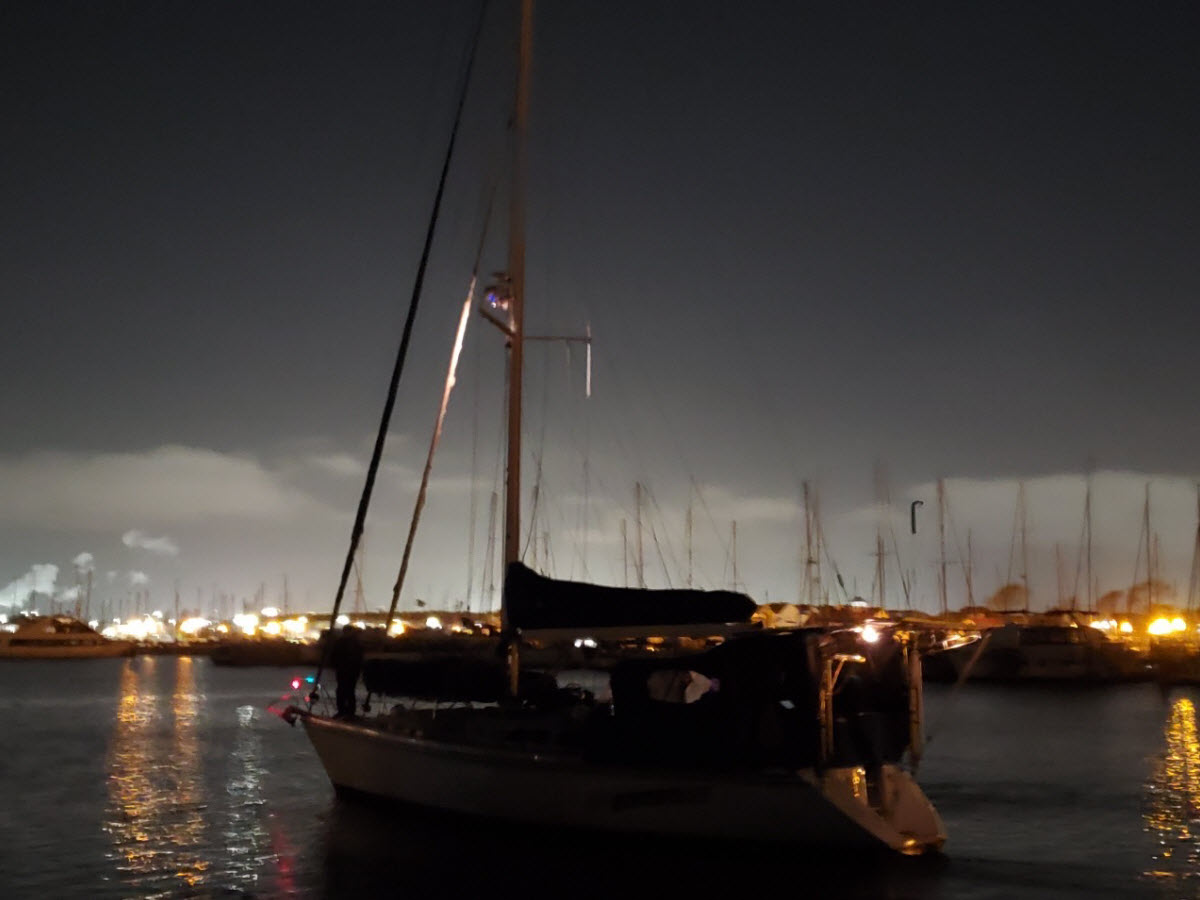
At 6 a.m. we left the safety of our slip in Marina Bay Richmond, California. As we were nearing the end of the very narrow channel, we saw the ferry to San Francisco barreling toward us. We knew they docked on side of the channel to our right, so I hugged the left side of the channel markers as tight as I could (not the way 2 vessels normally pass each other). Sean went to the bow to send directions back for any course corrections. Just as we cleared the ferry and entered the larger channel, Sean yelled that there was a moving cargo ship ahead of us. In the dark, it was hard to see which direction they were going. I thought the tugs were pushing the ship into the docking area to our right side. So, I again hugged the channel makers to our left. But, through dramatic gestures and yelling, Sean made it clear that the ship and the 2 tugs were going in the same direction as we were, and we were not going to be able to outrun them. So, I turned the boat around and fell in behind the whole massive mess. Although my brother, Tim, has sailed on Adventure in the South Pacific, this was his first time in a very crowded harbor situation. Sean and I have experienced this other times, but it’s always worse in the dark and was quite a stressful way to start our trip!
We were happy that our long-sought journey was at hand, but apprehensive about what was ahead as we motored under the Golden Gate Bridge. Due to prevailing wind and wave directions, we expected to motor for the entire journey. Sean had found a book that gave waypoints for a “crab-pot-free” route up the coast, so we set our autopilot to that course and settled into the large open-ocean swells that greeted us. It wasn’t long before I ran below to get the Ondansetron (generic Zofran) my doctor had prescribed for sea sickness. I told her that the only thing that has worked well for me is Stugeron Forte that I picked up in Mexico (just 1/7 of a small pill is all I use). She prescribed what I thought was the generic version *it wasn’t*. Soon after taking the pill, my whole body started shaking, almost like I was shivering. And to be fair, I was bundled up, but still quite cold. So, I chalked it up to that and trying to get used to the frightening new situation out in the big ocean.
Then came the crab pots. First, just a few that we easily avoided with a few-degree twist of our autopilot control. But then we were in the middle of a long line of pot buoys. I turned off the autopilot and started toward land, following the long line of buoys as the guys pointed them out. We realized this strategy was just leading us into more crab pots, so we made the decision to weave through the buoys and head out toward deeper water, leaving the crab pot mess behind. The conclusion is that the guidebook must have been showing the “maximum crab pots” route. It was stressful but gave us something to focus on as we struggled to get our sea legs, and I continued to have body tremors.
We saw several whales spouting, but not close to the boat. There were about 5 boats (2 fishing boats, a large container ship, and 2 we only saw on the radar) within 8 miles of us through the entire 35-hour trip. We didn’t feel well enough to drop a line in to try fishing. I paid $15 to be on the National Saltwater Angler Registry which allows fishing 3 miles or more from shore, where state regulations end.
Our night watches go like this: Shifts are for 2 hours. With 3 people aboard, we have primary and secondary watches that are in the cockpit and exposed to the elements and a sleeper that is below in the aft cabin, enveloped by 2 comforters, 4 fluffy pillows, and the warmth and gentle hum from the engine. The primary watch person responsibilities are (in this order): set a 20-minute timer that is located at the helm, check the radar for any vessels in the area, do visual scan for vessels, make course changes as needed, try to regain body heat lost from standing up by bundling under a blanket until the timer goes off again. The secondary watch is also awake with the alarm and available to confer with when needed, help to trim sails if needed, and may also do a visual check of surroundings. This is repeated every 20 minutes for a 2-hour shift. Then, the secondary becomes the sleeper, the sleeper becomes the primary, and the primary becomes the secondary. It’s a great system for keeping the most rested and alert person at the helm.
During my first sleep shift, I was awakened by something hitting our boat. Tim and I saw a full telephone pole-sized log a few yards from our boat at one point, so I suspected it was a log. When I didn’t hear an alert from the boys, I fell back to sleep. Sean thinks it hit our prop, but nothing seemed to change in terms of speed, sound, or water intrusion, so we’ll try to get a camera on it when we get to port.
Our autopilot started failing periodically during the day. It would beep, indicating it couldn’t maintain rudder direction. We would turn it off, steer to our course, and then turn it on again. This seemed to work well for an hour or two before it would fail again. When I started my primary watch shift (the last night shift before morning), it started failing every five or ten minutes. This, along with the 20-minute timer had me constantly attending to the boat. It was a very long 2-hour shift! I was exhausted when Sean came up 2-hours later and I still had body tremors and seasickness (I had taken my second seasickness pill that night). Tim was awake with the daylight and didn’t want to go down to sleep, so I went down and crashed. The guys figured out that our course had something to do with the autopilot failing, so were able to get it to hold longer by going off-course a bit. They let me sleep 3 hours or so and woke me up to get ready to bring Adventure into Fort Bragg harbor. When I woke up, my body shaking had finally stopped, I wasn’t seasick, and I was hungry. I later read that muscle twitching is a known side effect of Ondansetron. It did keep me from vomiting, but I don’t think it’s the right med for me. I think I’ll try my old Stugeron I have from 18 years ago on the next leg of the trip.
Author: Kathy; Photo by Sheldon, our Marina Bay friend, as we left the dock.
 Tales of Misadventure
Hope you get your sea legs quickly❤️ Praying for you all!
LikeLike